Speed of Play: Why the Fastest Players Aren’t Always the Quickest
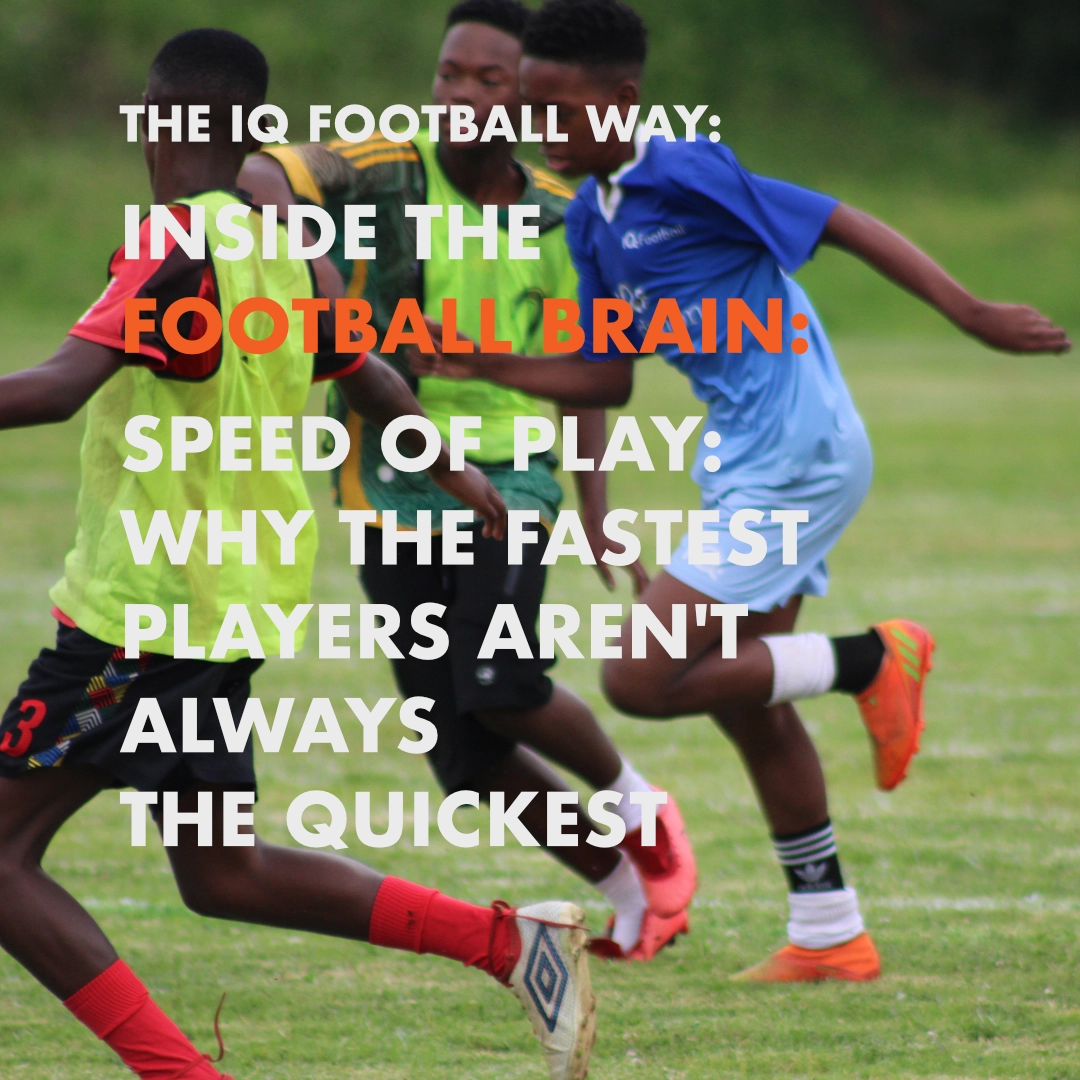
When people think about speed in football, they often picture explosive sprints, powerful acceleration, and players racing past opponents. Physical speed is certainly valuable, but at the highest levels of the game, another type of speed becomes even more important. The players who consistently influence matches are often not the quickest runners. Instead, they are the players who process information the fastest. Their ability to see, understand, and act upon what is happening around them allows them to play at a speed that others struggle to match.
At IQ Football, we call this Speed of Play. Speed of Play refers to the ability to perceive information, make decisions, and execute actions quickly and effectively under pressure. It is a cognitive skill as much as a physical one. The faster a player can process information and identify solutions, the more time and space they appear to have on the field.
The Brain is the Engine Behind Every Action
Every movement in football begins in the brain. Before a player can pass, shoot, dribble, or change direction, the brain must first gather information from the environment. It receives visual information about teammates, opponents, and available space, while also processing signals from the body’s sensory systems. The brain then interprets this information, predicts what is likely to happen next, selects an appropriate response, and sends instructions to the muscles. Remarkably, this entire sequence takes place in fractions of a second.
Neuroscientists describe this process as the perception-action cycle. Players are constantly collecting information, interpreting it, and responding accordingly. Football places extraordinary demands on this system because the environment changes continuously. Every movement by a teammate or opponent creates new possibilities and new challenges. The players who can process these changes most efficiently are able to make better decisions more quickly.
Why Some Players Always Seem to Have More Time
One of the most fascinating characteristics of elite players is that they often appear to have more time on the ball than everyone else. This is not because defenders are giving them extra space. Rather, it is because they have already processed much of the available information before the ball arrives.
Throughout his career, Kevin De Bruyne has demonstrated this principle repeatedly. He is not known primarily for extraordinary sprinting speed, yet he consistently plays forward passes that seem impossible to see. By the time he receives possession, he has often already scanned the field multiple times and identified potential opportunities. His brain has effectively completed much of the decision-making process before the ball reaches his feet. As a result, he can execute actions with remarkable speed and precision.
This ability is closely linked to a concept in neuroscience known as predictive processing. The brain does not simply react to events as they occur. Instead, it constantly generates predictions about what is likely to happen next. Elite players become exceptionally skilled at recognising patterns and anticipating future events. This allows them to act earlier and more decisively than their opponents.
The Importance of Scanning
Scanning is one of the most important habits in football because it provides the brain with the information it needs to make accurate predictions. Every time a player looks around the field, the brain updates its internal map of the environment. It gathers information about space, pressure, teammate positioning, and opponent movement.
The more information a player gathers before receiving the ball, the less time is needed to process information after receiving it. This is why elite players are constantly checking their surroundings. Frequent scanning reduces uncertainty and allows the brain to prepare potential solutions in advance. When possession is received, the player is already several steps ahead in the decision-making process.
From a neuroscience perspective, scanning improves situational awareness and enhances the brain’s ability to anticipate future events. This enables players to play with greater confidence, accuracy, and speed.
Cognitive Load and Performance Under Pressure
Many players perform well in isolated technical drills but struggle when faced with the demands of a real match. One explanation lies in the concept of cognitive load. Cognitive load refers to the amount of mental effort required to process information at any given moment.
Football presents players with an enormous amount of information simultaneously. They must monitor teammates, opponents, available space, tactical instructions, and the movement of the ball while also preparing their next action. When the brain becomes overloaded, processing slows down. Decision-making becomes less efficient and technical execution often suffers.
This is why players can appear slow under pressure even when they possess excellent technical skills. The challenge is not always technical ability. The challenge is often the brain’s ability to manage large amounts of information quickly and effectively.
Neural Efficiency and Automaticity
Another reason elite players can play at such high speeds is that many of their technical actions have become automatic. Through repeated practice in realistic environments, neural pathways become stronger and more efficient. The brain no longer needs to devote significant attention to basic technical execution.
This process is known as automaticity. When a player no longer has to consciously think about receiving, passing, or turning, valuable mental resources become available for decision-making and problem-solving. The player can focus on reading the game rather than controlling every movement. At IQ Football, we focus on the process of motor skill learning so that a player properly transitions from cognitive, to associative and finally autonomous.
Neuroscience research consistently demonstrates that experts develop more efficient neural networks for skills they practise regularly. As these networks become stronger, processing becomes faster and requires less mental effort. This creates the impression that elite players can think more quickly, when in reality they have simply become more efficient at using their cognitive resources.
Why Traditional Training Often Misses the Mark
Many traditional football drills focus heavily on technique while placing limited demands on decision-making. Players may perform the same movement repeatedly in predictable environments without needing to solve problems or adapt to changing situations.
While repetition can improve technical execution, it does not necessarily improve game intelligence. Football is not a game of repeating identical movements. It is a game of solving constantly evolving problems. Players must learn to perceive information, anticipate outcomes, and make effective decisions under pressure.
If coaches want to improve Speed of Play, training must challenge the brain as well as the body. Players need opportunities to scan, adapt, predict, and make decisions in environments that closely resemble the demands of the game.
How IQ Football Develops Speed of Play
At IQ Football, our player-centred model recognises that football intelligence can be developed through deliberate training. Our NeuroFootball approach is designed to strengthen the cognitive skills that underpin fast play. Players are regularly exposed to activities that require scanning, anticipation, pattern recognition, decision-making, and rapid adaptation.
Rather than simply instructing players what to do, we create learning environments that encourage them to discover solutions for themselves. This approach strengthens the perception-action cycle, improves predictive processing, and develops greater neural efficiency. As players become more skilled at gathering and interpreting information, they learn to make better decisions with greater speed and confidence.
Over time, this leads to improvements that extend far beyond technical ability. Players become more adaptable, more creative, and more effective under pressure. Most importantly, they learn how to think quickly in a game that is becoming faster every year.
The Real Meaning of Speed of Play
The fastest player on the field is not necessarily the player who can run the quickest. The fastest player is often the one who recognises opportunities first, predicts events sooner, and makes effective decisions before everyone else. Physical speed may create an advantage, but cognitive speed often determines success.
Speed of Play begins in the brain. When we develop the brain, we develop the player. When players learn to process information more effectively, the game appears to slow down around them. That is the true power of NeuroFootball training, and it is why the future of player development lies not only in training the body, but also in training the mind.
Football, neurofootball, neuroscience, neuroscience in sport, Soccer, Speed of play