The Brain Hates Surprises: What Football Teaches Us About Learning
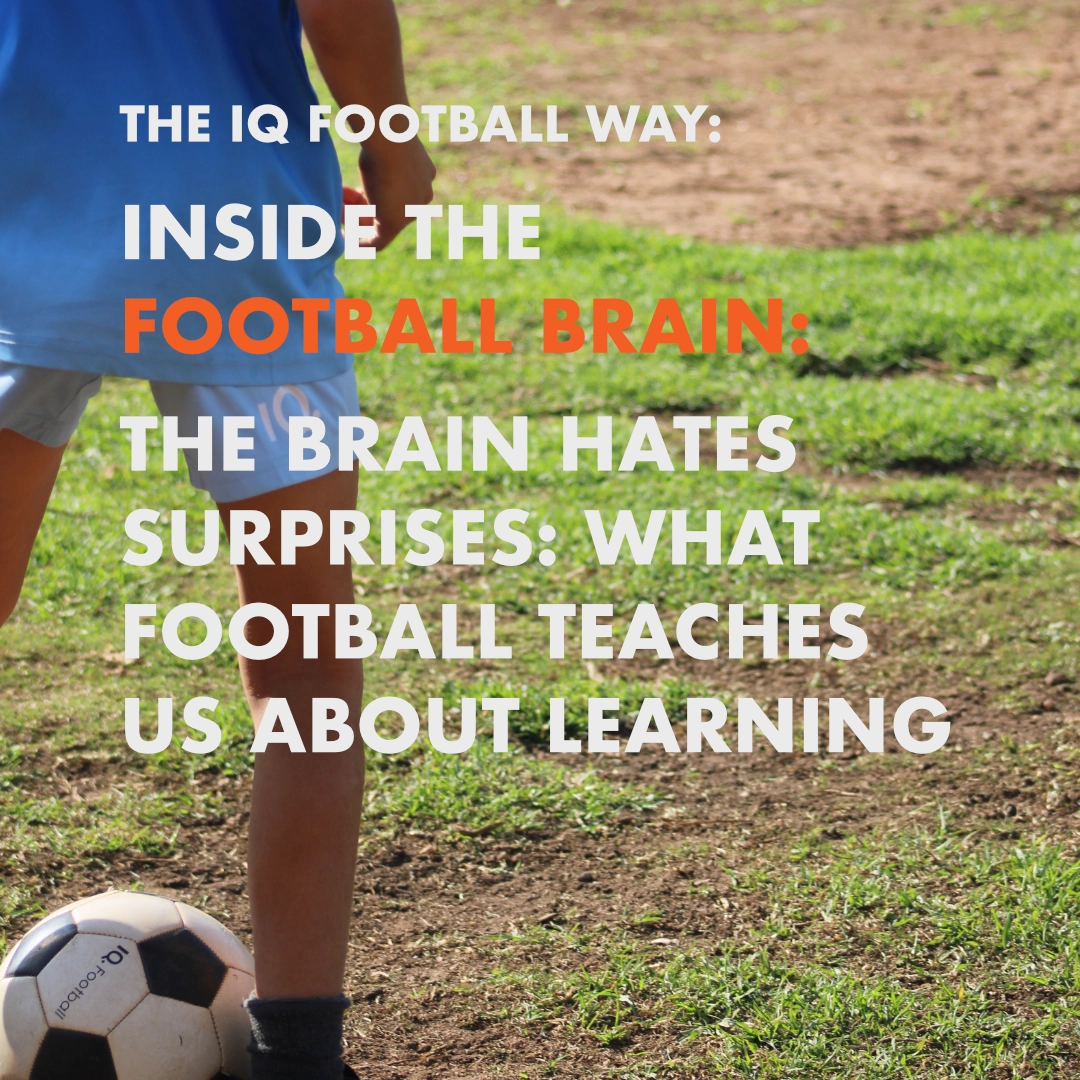
A fascinating discovery in neuroscience is that the brain is constantly trying to reduce surprises. When something unexpected happens, the brain creates a “prediction error” signal. This signal tells us that reality did not match our expectations.
In football, players who can accurately predict what is about to happen experience fewer prediction errors and can play more fluently. Young players often struggle because the game keeps surprising them.
At IQ Football, our training isn’t just teaching players what to do. It’s helping them build better internal models of the game so they are surprised less often.
The brain loves patterns
Chess masters don’t see thirty two individual pieces, they see patterns. Football works the same way. Experienced players don’t process eleven opponents and ten teammates individually. Their brains “chunk” information into familiar patterns. This explains why experienced players make decisions so quickly. The more game situations a player experiences, the more patterns their brain stores and the faster their decision-making becomes.
It is tempting to put Premier League player’s success down to talent. We assume they were born with better instincts or a special feel for the game. Neuroscience offers a different explanation.
Prediction errors and the “prediction machine”
The human brain is constantly making predictions. Every second of every day, your brain is trying to work out what will happen next. It uses past experiences, patterns, and information from the environment to create an internal model of the world. Rather than waiting for events to unfold and then reacting, the brain is continuously forecasting what is likely to happen.
In fact, some neuroscientists describe the brain as a “prediction machine.” When reality matches the brain’s prediction, everything runs smoothly. The brain can process information efficiently and use less energy. But when something unexpected happens, the brain generates what scientists call a prediction error. A prediction error is simply the gap between what the brain expected and what actually happened.
Imagine a defender shaping to pass wide, but instead playing a quick pass through the middle. If a player expected the wide pass, their brain must suddenly update its prediction and react to the unexpected information. That moment of surprise costs valuable time. Football is full of prediction errors.
How IQ Football uses this research
For young players especially, the game can feel like a constant series of surprises. The ball moves faster than expected, opponents appear from nowhere, passing lanes close unexpectedly, and decisions arrive before they feel ready. This is one reason football can feel overwhelming for developing players.
As players gain experience, however, something remarkable happens. Their brains begin to build more accurate models of the game. They start recognising patterns that were previously invisible. They learn what certain movements usually mean. They notice clues in body position, spacing, and timing. Gradually, the game becomes less surprising.
The best decision is often made before the ball even arrives. That is why we place such a strong emphasis on game understanding. Through scanning, small-sided games, guided discovery, and decision-making challenges, players are continually learning to recognise patterns and adjust their predictions.
We want players to become active thinkers rather than passive participants. Importantly, prediction errors are not something to avoid completely. In fact, they are essential for learning. The brain grows when its predictions are challenged.
Every time a player expects one outcome and experiences another, the brain updates its internal model. Done in the right environment, mistakes become valuable learning opportunities rather than failures. The player is not simply getting something wrong; they are refining their understanding of the game.
This is one reason why asking questions can be more powerful than giving answers. When players are encouraged to think, predict, and reflect, they become more engaged in the learning process. They begin to understand not only what happened, but why it happened. And that understanding extends beyond football.
Developing intelligent players on, and off the field
Life constantly presents situations we do not expect. Plans change, challenges arise, and people surprise us. The ability to learn from unexpected outcomes, adapt our thinking, and make better predictions in the future is a skill that serves us well both on and off the field.
Football provides countless opportunities to practise this skill. Every training session becomes an exercise in learning, adapting, and refining our understanding of the world around us. Perhaps that is why football is such a powerful teacher. The brain may hate surprises, but it learns because of them.