Mistakes, emotions & confidence
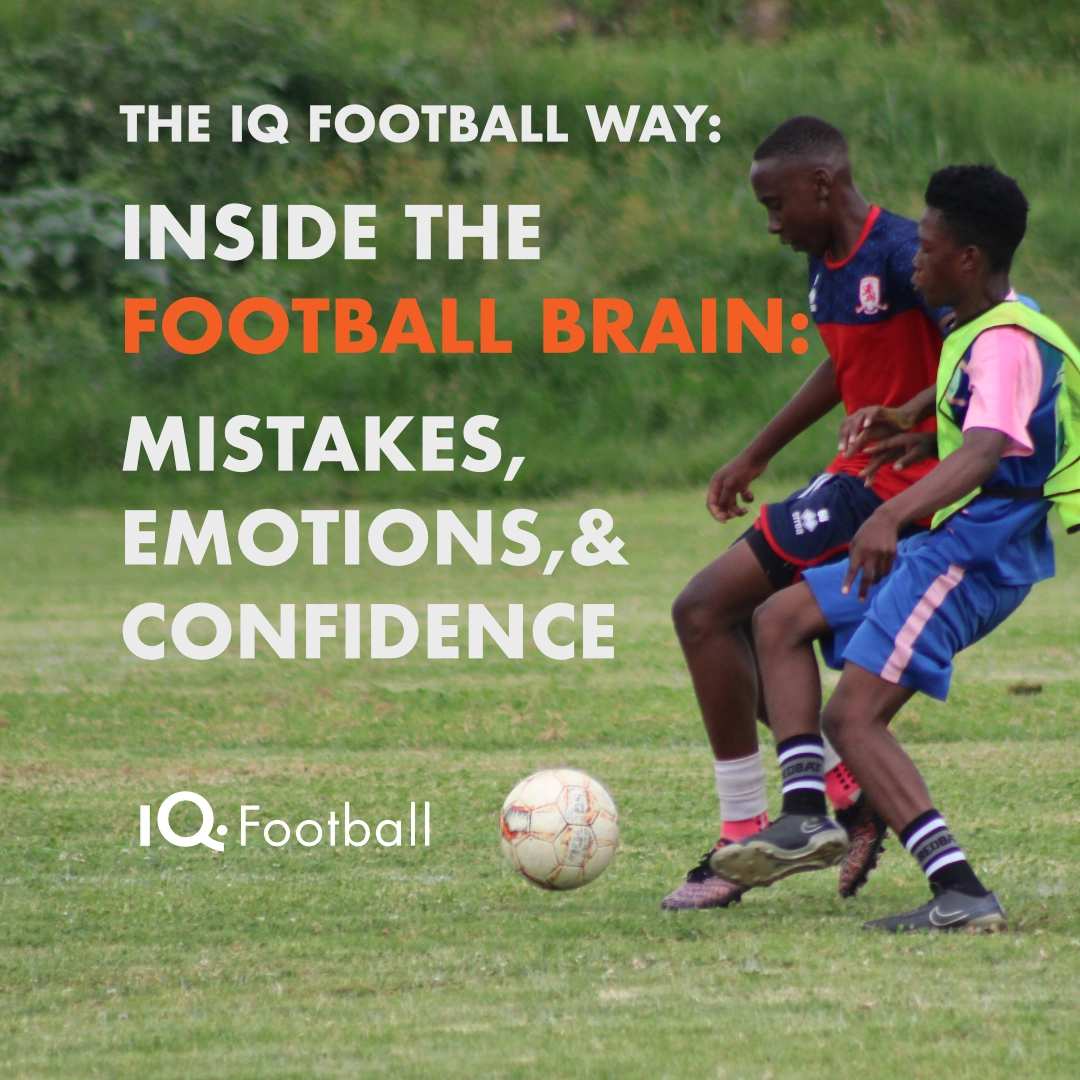
In my years of coaching youth football, and in life in general, I’ve experienced that the moments that shape a person are not always the goals they achieve, but how they respond when things go wrong.
A mistake made under pressure can either become a source of growth or a trigger for fear and withdrawal.
Our focus is on helping young players understand what is happening inside their brains during these moments, and how to build emotional control and real confidence from the inside out. By shifting how mistakes are perceived and managed, we help shape people who are not only more resilient, but also more creative and courageous on, and off the field.
What happens in the brain after a mistake
When a player makes a mistake, their brain reacts instantly—often before they are even consciously aware of it. The brain has a built-in monitoring system known as the Error Detection System, which flags when something doesn’t go as expected. The brain’s “EDS” is one of the most important mechanisms for learning, especially in fast, decision-based environments like sport.
This signal is incredibly valuable because it is what drives learning and improvement. However, for young players, this process is often accompanied by frustration, embarrassment, or even panic.
These emotional responses are not signs of weakness; they are natural neurological reactions. The challenge is that if a player gets stuck in that emotional state, learning actually slows down. Instead of adapting, the brain becomes overwhelmed. Let’s look at what’s happening in the brain during this process.
The error detection system
At its core, the Error Detection System is the brain’s ability to constantly compare what you intended to do with what actually happened. The moment there is a mismatch, the brain flags it as an error and begins the process of correction and learning.
From a neuroscience perspective, this process is largely driven by a region called the Anterior Cingulate Cortex (ACC). We love the 3D brain that can show you each part and its purpose. The ACC is hiding in the frontal part of the brain’s medial wall.
The ACC acts like a performance monitor. It is always scanning for conflicts—whether that’s the wrong movement, a mistimed pass, or even a poor decision. What’s fascinating is that this detection happens extremely quickly, often before the player is consciously aware they’ve made a mistake.
When an error is detected, the brain produces a signal known as the Error-Related Negativity (ERN). This is a measurable electrical response that occurs within milliseconds after a mistake. In simple terms, the brain is saying, “That didn’t go as planned—adjust.” This signal is what drives immediate behavioural changes and long-term learning.
At the same time, another part of the brain, the Prefrontal Cortex, is recruited to help adjust strategy and improve decision-making. This is where conscious correction happens—choosing a different pass, adjusting positioning, or slowing down under pressure.
However, this system does not work in isolation. It is strongly influenced by emotion, particularly through the Amygdala. If a mistake is perceived as threatening—because of fear, pressure, or criticism—the amygdala can amplify the emotional response. When this happens, it can actually interfere with the prefrontal cortex, making it harder for the player to think clearly and learn from the mistake.
This is why two players can respond so differently to the same error. One player resets quickly and improves, while another becomes frustrated, anxious, or hesitant. The difference is not ability—it is how their brain processes and regulates the error signal.
Importantly, the error detection system is not designed to punish—it is designed to teach. Every mistake provides data. When the environment is supportive and the emotional response is managed, the brain uses these signals to strengthen neural connections and refine performance. This is how skill is built over time.
In young players, this system is still developing, which means they are more sensitive to emotional reactions and external feedback. If mistakes are consistently paired with negative responses, the brain can begin to associate errors with threat rather than learning. Over time, this reduces risk-taking and slows development.
But when mistakes are normalised and followed by calm, constructive responses, the brain stays in a learning state. The ACC continues to detect errors, the prefrontal cortex adjusts behaviour, and neural pathways become more efficient. This is the foundation of improvement, confidence, and ultimately, high-level performance.
Understanding this system changes how we coach and how we parent. Instead of trying to eliminate mistakes, we start using them deliberately—as the brain’s most powerful tool for growth. Over time, players begin to see mistakes not as failures, but as essential feedback that helps them improve.
Fear, pressure & performance in young players
Pressure changes how the brain functions, especially in young athletes. When a player feels judged, rushed, or afraid of making mistakes, the Amygdala becomes highly active. This part of the brain is responsible for detecting threats, and in a football context, it can interpret pressure as danger. When this happens, it reduces the effectiveness of the Prefrontal Cortex, the area responsible for decision-making, focus, and control.
What is significant is that the amygdala determines threats – but not in a perfectly rational or accurate way. The amygdala does not “think” like the logical brain. Instead, it makes fast, automatic predictions about danger based on past experiences, patterns, and emotional memory. Its priority is speed over accuracy.
This means it can correctly identify real danger (e.g., physical risk), but it can also misinterpret non-dangerous situations as threats. For example in young footballers, a coach shouting can be interpreted as danger; making a mistake in front of others can be interpreted as social threat; pressure in a match can be interpreted as risk of failure or embarrassment. Even though none of these are physically dangerous, the amygdala can still activate a full stress response.
How it interacts with thinking and performance
The amygdala is closely linked to the Prefrontal Cortex, which we’ve mentioned is responsible for decision-making, focus, and control. When the amygdala is calm, the prefrontal cortex works well, which results in clear thinking and good decisions. When the amygdala is highly activated, it can override the prefrontal cortex and result in impulsive reactions, poor decisions, or “choking” under pressure.
This is why a skilled player can suddenly make simple mistakes in a high-pressure moment – their brain has shifted into a threat state. Helping players understand this removes shame and replaces it with awareness. More importantly, it allows coaches to train for these moments. By gradually introducing pressure in a controlled and supportive environment, players learn to stay calm and think clearly.
Techniques like breathing, grounding, and reframing pressure as excitement can significantly improve performance. The goal is not to eliminate pressure, but to help players experience it as something they can handle.
Why confidence is a brain state, not a personality trait
Confidence is often misunderstood as something a player either has or doesn’t have. In reality, confidence is not a fixed personality trait—it is a brain state that changes based on experience and perception. It is built through the strengthening of neural pathways, which develop through repetition, success, and reinforcement.
When a player experiences small successes consistently, their brain begins to predict positive outcomes. This prediction creates a sense of belief, which we recognise as confidence. However, because it is state-based, confidence can fluctuate from day to day. A player who appears confident in one session may struggle in the next, depending on their recent experiences and emotional state.
Understanding this is powerful for both coaches and parents. It shifts the focus from labelling players to supporting them. By designing training sessions that allow for frequent small wins, and by using language that emphasises effort and process rather than talent, we actively build confidence in the brain. Over time, players develop a more stable sense of belief in their abilities, not because they were told they are talented, but because their experiences have shown them they can succeed.
How adults can help the brain recover faster
The role of adults in a young player’s development goes far beyond instruction. Coaches and parents play a critical role in how quickly a child recovers from mistakes and emotional setbacks. This is because children rely heavily on co-regulation, meaning their emotional state is influenced by the adults around them.
Tone of voice, body language, and timing of feedback all send powerful signals to a child’s brain. Immediate criticism or visible annoyance after a mistake can keep the brain in a defensive state, slowing learning and reducing confidence. In contrast, calm and supportive responses help the brain feel safe, allowing it to reset and refocus more quickly.
When we are more aware of this as parents, becoming very intentional about our responses to mistakes that happen at school or home, is something we can practise and get really good at – for ourselves and our children. Repeatedly speaking words like: “we all make mistakes”, “what a great lesson we can learn from this mistake”, or “oops dad made a mistake, we’re all learning and growing,” normalises mistakes. This helps to reframe them from a fearful experience to a learning opportunity. And we all know tone is as important as the words spoken.
Creating an environment of psychological safety does not mean removing challenge or avoiding correction. It means delivering feedback in a way that supports learning. When players feel safe to make mistakes, they become more willing to take risks, try new skills, and push their limits.
When adults respond intentionally by connecting with the player, offering clear correction, helping players come up with a solution and reinforcing effort, we create a system where emotional recovery becomes faster and more effective. The result is not just better performance, but healthier, more resilient young athletes who enjoy the game and continue to grow within it.
Key summary
For young players, confidence is not just skill, it’s feeling safe enough to perform. Emotional reactions after mistakes are brain-based, not behavioural issues. The environment (coach tone, parent reactions, pressure levels) directly shapes how active the amygdala becomes.
When adults create a calm, supportive environment, the amygdala stays regulated, allowing learning and performance systems to function properly. By understanding the brain’s response to mistakes, pressure, and feedback, we move beyond traditional coaching and into a space where football becomes a powerful tool for building resilience, emotional intelligence, and lasting confidence on, and off, the field.
amygdala, Brain, Confidence, emotions, fear, Football, Growth Mindset, learning opportunities, mistakes, neuro football, prefontal cortex, Soccer
