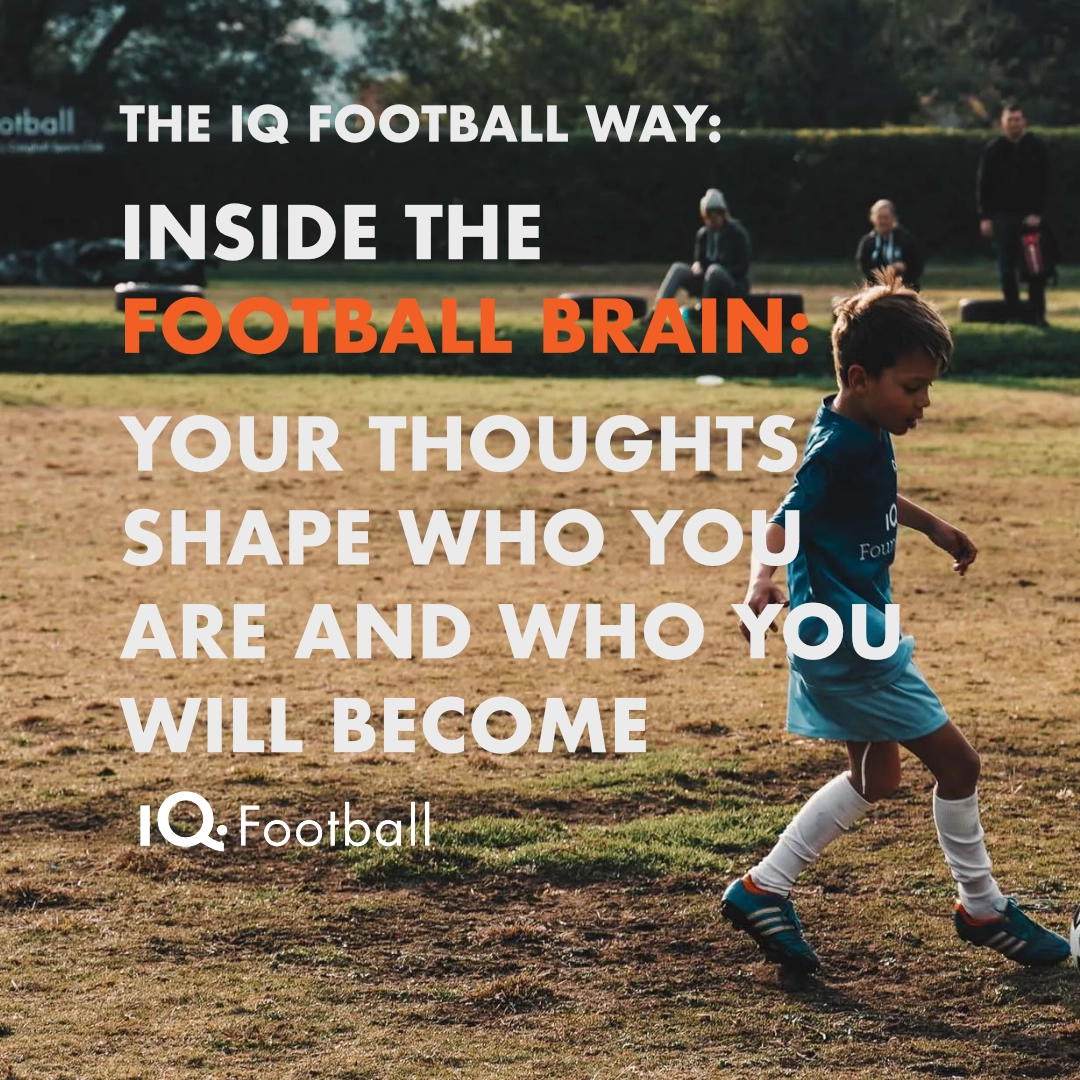
Your Thoughts Shape Who You Are and Who You Will Become
The Neuroscience Behind Thought and Development
At IQ Football, we use our motto because it’s a truth backed by decades of research into how the brain works, how it learns, and how it grows. When we say “Your thoughts shape who you are and who you will become”, we mean that your mindset will determine your output. Your thoughts precede your actions. What you think, is how you will act. The great news is that your brain is malleable, and thus has the ability to change throughout your life.
We’re talking about neuroplasticity — the brain’s remarkable ability to reorganise itself based on experience, practice, and mindful effort. We’re also talking about a person’s Reticular Activating System (RAS), which we’ll touch on later. First let’s discuss thoughts and neuroplasticity.
Thoughts and Neuroplasticity
Our brains have around 86 billion nerve cells called neurons interconnected by trillions of connections called synapses. In neuroscience, a “thought” is generally defined as a pattern of neural activity.
Synapses change their strength based on use (neuroplasticity). When you learn something new, specific synapses become stronger, making it easier for that specific “thought pattern” to fire again in the future.
A single synapse firing does not constitute a thought. Instead, thoughts emerge from the simultaneous activity of millions of neurons across distributed networks.
Modern research (2025-2026) describes thoughts as “trajectories of population activity”—essentially a specific “shape” or path that electricity takes through your brain’s wiring.
Large networks of neurons firing together create what we experience as:
- An idea
- A memory
- A belief
- A decision
- A fear
- A strategy
Neuroscientist Donald Hebb famously summarised this with:
“Neurons that fire together wire together.”
This principle — now called Hebbian learning — explains how repeated thoughts strengthen neural pathways. The more often you think a certain way, the more efficient and automatic that pattern becomes. This works both ways – for positive and negative thoughts.
What Neuroscience Tells Us About Neuroplasticity – how thoughts change the brain
Your brain is malleable. It has the ability to reorganise itself. It has a dynamic capacity shaped by experience and thought. The brain continually rewires itself based on how often and how deeply we engage with patterns, challenges, and feedback — a concept called neuroplasticity. This means that every thought, choice, and practice lays groundwork for future ability and identity. This means that every time a child thinks about a challenge, practices a skill, or visualises success, they are literally reshaping their neural pathways.
Research led by Michael Merzenich demonstrated that the brain physically rewires itself based on repeated mental activity and training. This means:
- Repeated anxious thoughts strengthen anxiety circuits.
- Repeated growth-oriented thoughts strengthen resilience circuits.
- Mental rehearsal activates many of the same brain regions as physical practice.
A famous experiment by Alvaro Pascual-Leone showed that participants who only mentally practiced piano developed measurable changes in motor cortex similar to those who physically practiced.
Thought alone changed brain structure. And in sport specifically, studies indicate that structured physical and cognitive training improves both technical skills and mental faculties like decision-making, attention, and anticipation — the very processes that distinguish good players from great ones. At IQ Football, we leverage these principles in every session — helping players not just train their legs, but train their minds.
One fascinating study found that through cognitive training, children can develop a growth mindset — a belief that abilities improve with effort. The researchers showed that such improvements in mindset were associated with changes in connectivity in brain regions tied to cognitive control, memory, and motivation.
One of our favourite studies, shows that in sports specifically, systematic football training doesn’t just improve physical fitness — it also positively impacts cognitive functions such as attention, inhibitory control, and working memory, reflecting underlying neurophysiological change in the brain.
Your subcontious beliefs
Your Reticular Activating System (RAS) helps you to focus, points out information that is important to you, and blocks out information that conflicts with the information stored in your subconscious.
This brings us to what we believe is the most powerful function of your RAS – that is to seek information that re-affirms or validates your belief systems. It filters the world through the framework you give it, and your beliefs are that framework.
Throughout your life — especially during childhood — you formed beliefs about the world, other people, and most importantly, about yourself. Those beliefs were shaped by experiences, feedback, repetition, and emotion. Over time, they became stored patterns in your subconscious mind.
Every time you reinforced a belief through repeated thoughts, you strengthened the neural pathways connected to it. The more often a thought is repeated, the more neurons wire together. Over the years, some beliefs can become deeply embedded — supported by large, well-established neural networks.
If those stored beliefs are positive — “I can learn,” “I improve with effort,” “I am capable” — that’s powerful. Your brain supports growth.
But if the beliefs are negative — “I’m not good enough,” “I always fail,” “I can’t handle pressure” — your brain will still reinforce them just as faithfully.
The Reticular Activating System (RAS)
This is where the Reticular Activating System (RAS) comes in. The RAS acts like a filter for your attention. It scans your environment and highlights information that matches what you already believe. If you believe the world is against you, you’ll notice evidence that confirms it. If you believe you struggle under pressure, your brain will spotlight moments that “prove” it.
Apply this to football.
If you believe you can’t pass well and that you rarely score, your brain will unconsciously look for moments that validate that belief. You may hesitate before passing. You may tighten up in front of goal. You may overlook the times you actually performed well. Gradually, your performance begins to reflect your belief.
Pause and think about that.
This is why we say: your thoughts shape who you are and who you will become. Your RAS will continue to reaffirm whatever belief is stored. It doesn’t judge whether the belief is true or false. It simply filters reality to match what is already wired in your brain. It will even minimise or ignore evidence that contradicts your internal story. That means if you want to elevate your performance on the football field, you cannot focus only on physical skill. You must address the beliefs underneath the performance.
Trying to change behaviour without changing belief is like trying to change the fruit without tending to the roots. If you don’t reshape the stored beliefs in your subconscious — the ones that have been wired through repetition — you will always feel as though something is holding you back.
But when you deliberately rewire your beliefs — through repetition, reflection, visualisation, and intentional training — your thoughts begin to align with growth. Your RAS begins to search for opportunities instead of threats. Your actions become more confident. Your performance expands. And over time, so does your identity. That is the deeper work. And that is why mindset training is not optional — it is foundational..
Dr Cobus Oosthuizen (PhD in Mentoring & Human Development), explains it like this: “You can’t make better decisions in life than what is stored in your subconscious. You need to change the stored information in your subconscious to be able to change.” This is personal work. It takes time to process what you truly believe about yourself. It takes intentional effort to surface the beliefs you have about yourself. At IQ Football, we teach that your thoughts matter. Your thoughts will come out in words and actions.
Noticing your or your child’s self-talk, is an incredible step forward. Changing your self-talk and setting your intent can begin to rewire your brain, so that you see a positive change in who you believe you are, and who you will become. Begin with what you believe. Discover your thoughts about yourself. Address the thoughts that do not align with a growth-mindset.
Brain-Centred Football Training at IQ Football
At its core, IQ Football’s training philosophy sees the brain as the central engine of performance — not just the legs or the muscles. We combine football coaching with neuroscience-based techniques, which means young players train:
- Cognitive skills: Pattern recognition, decision-making under pressure, spatial awareness, and memory.
- Motor skills integration: Coordinating body and mind during complex drills that reflect real game situations.
- Visualisation and mental rehearsal: Practising mentally as well as physically to strengthen neural response patterns.
- Reaction time and attention training: Exercises designed to sharpen focus and speed neural signalling between brain and body.
This holistic approach recognises that thoughts are not passive — they are driving forces behind skill acquisition, resilience, confidence, and adaptability on and off the pitch.
Why Thoughts Really Matter in Sport and Life
Our thought patterns influence how we interpret challenges, how we respond to setbacks, and how consistently we put in effort. From a neuroscience perspective, positive, growth-oriented thoughts encourage neural pathways that support perseverance and learning. Mental rehearsal and visualisation create measurable brain changes — the brain fires as though the skill is physically practised. Cognitive engagement during practice accelerates decision-making and game intelligence, leading to smarter on-field performance.
This is why IQ Football doesn’t just teach kids how to kick a ball, but how to think like a player — strategically, creatively, and with confidence.
We believe that by shaping the brain early — teaching children how to think, not just what to do — we help them become better players and resilient young people.
What Parents and Players Are Saying
The real proof of impact often comes from families in the club. Here are some reviews and testimonials from parents and community members — from our business listings and online profiles:
“In the time my sons have spent with Sean and his team … I’ve seen a real transformation! The IQ philosophy and coaching approach is truly remarkable. Not only do they teach soccer skills, but also teamwork and manners. We’re thrilled to be part of the academy.”
— Parent Review
“Our boys have been training with IQ Football for years and have improved so remarkably. They don’t just learn technique — they learn self-belief, confidence and smart decision making.”
— Parent Review
Reviewers from community directories and engagement sessions describe the experience similarly:
“Coach Essien delivers age-appropriate, engaging activities. Our 4-year-old is so excited to go each week — even our 2-year-old can’t wait to start!”
— Community Review
“Sean puts so much thought into every training session. I’ve seen real development in my son’s play — both technically and mentally.”
— Community Review
We often hear from parents about IQ Football being an environment for fun, care and confidence-building. We’re not just a club training athletes, but nurturing kids who feel excited to learn — which is exactly what neuroscience tells us boosts long-term growth and neural wiring.
In Summary your thoughts shape who you are and who you will become.
When a child trains their mind as much as their body, they’re not just learning football — they’re training the brain to stay calm under pressure, think faster, adapt to change, and believe in their own capacity to grow. This translates to every area of life. Mental discipline determines outcomes.
At IQ Football, this isn’t an abstract idea — it’s daily practice grounded in real neuroscience. Whether a child dreams of playing professionally or is simply learning to play the game they love, the way they think will determine who they are and who they will become.
Cognitive development, Football, Growth Mindset, Hebbian learning, Neuroplasticity, Reticular Activating System, Soccer, sports and neuroscience, Thoughts
